
A Name Borrowed Across Europe
Faenza is a mid-sized city in the province of Ravenna, in the Emilia-Romagna region of northern Italy. Its ceramic workshops were sufficiently active and well-distributed across European trade routes by the sixteenth and seventeenth centuries that the French word faïence — and subsequently English faience — derived directly from the city's name. The same derivation applies in German (Fayence), Dutch (faience) and several other European languages.
This linguistic adoption indicates the volume and visibility of Faenza's exports to France and the Low Countries during the period. French and Dutch potters who attempted to replicate the white-glazed earthenware they imported referred to it by its city of origin — a pattern also seen with Delft (from Delftware) and Limoges (for porcelain).
On the word "faience": In contemporary ceramic terminology, faience is used inconsistently. In French usage, it encompasses most tin-glazed earthenware regardless of origin. In Italian usage, faenza as a material term is less common — Italians typically say maiolica. In Anglophone scholarship, faience sometimes refers specifically to the ancient Egyptian blue-green quartz-frit material, distinct from Renaissance tin-glazed ware. Context determines which meaning applies.
Faenza's Ceramic Geography
Faenza sits at the foot of the Apennines where the Lamone river exits the hills onto the Po valley plain. The surrounding territory contains clay-bearing deposits used by local potters from at least the early medieval period. The town's position on the Via Emilia — the ancient Roman road connecting Rimini to Piacenza — gave it access to the commercial networks that distributed its wares northward into France and southward into Tuscany and Rome.
Unlike Deruta, which specialised predominantly in decorative ware, Faenza's production historically covered a wider range of object types: tableware, apothecary vessels, devotional tiles, floor pavements and architectural decorations. The diversity of output contributed to the broad recognition of the Faenza name across different market segments.
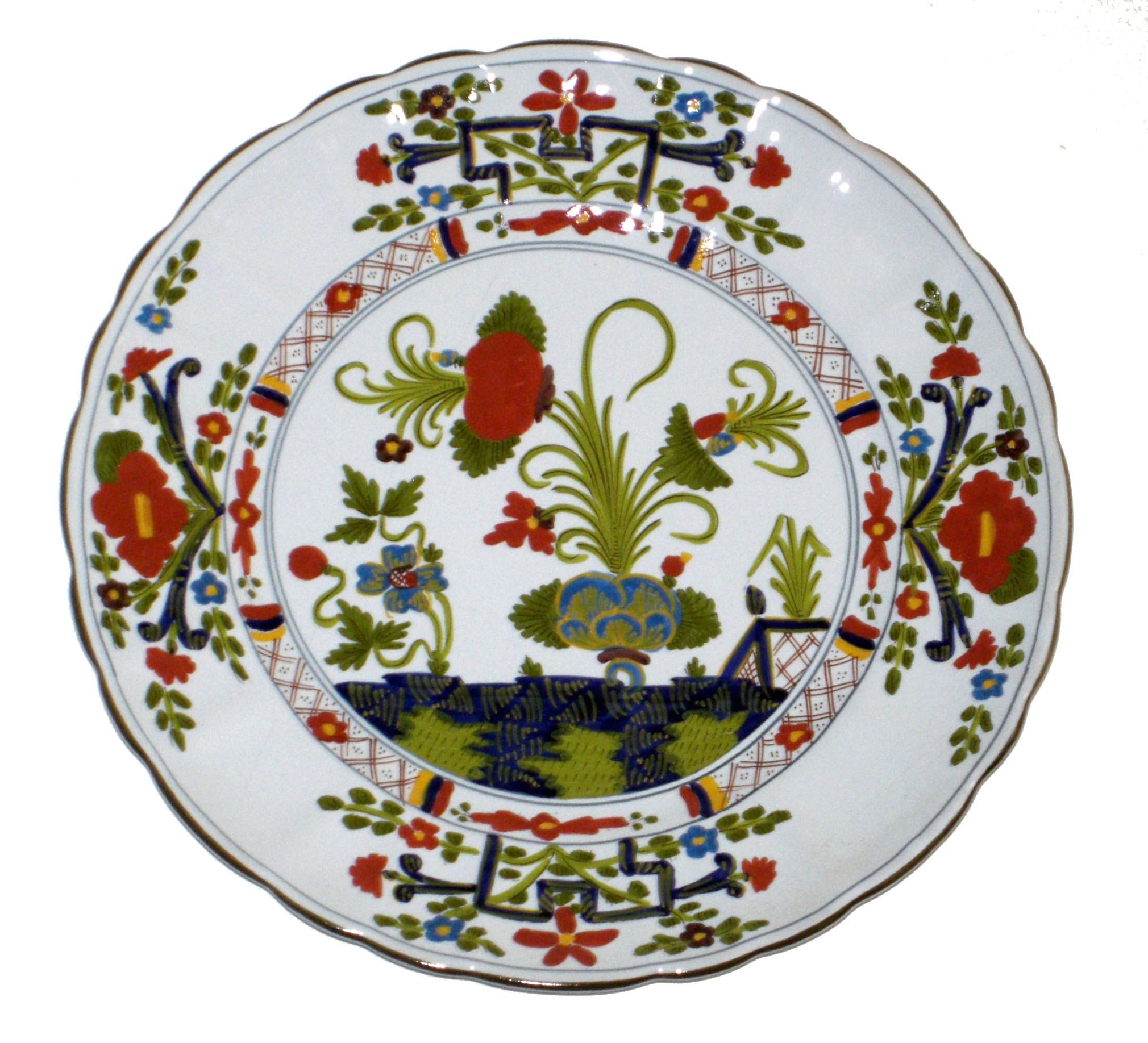
The Garofano Style
Among the decorative traditions associated specifically with Faenza is the Garofano (carnation) pattern — a repeating floral motif featuring stylised carnation flowers, typically painted in cobalt blue with orange or manganese accents against the characteristic white tin-glaze ground. The pattern emerged during the fifteenth century and became closely identified with Faenza production, to the point where it appears in pottery dictionaries as a marker of regional origin.
The carnation motif connects to a broader European decorative vocabulary of stylised floral ornament that circulated through trading networks linking Italy, Spain, the Ottoman Empire and Northern Europe. Similar motifs appear in Iznik pottery from Anatolia and in Hispano-Moresque wares from Valencia, suggesting common decorative sources adapted by different regional traditions.
Cafaggiolo and the Florentine Connection
Faenza's influence extended to workshops in other Italian cities that employed Faenza-trained potters or adopted its technical methods. The Cafaggiolo workshops near Florence, active in the early sixteenth century under Medici patronage, produced maiolica whose technical characteristics and some decorative choices reflect Faenza-derived practice.

The Museo Internazionale delle Ceramiche
Established in 1908 by Gaetano Ballardini, the Museo internazionale delle ceramiche in Faenza (MIC) is the largest ceramic museum in Italy by collection scope. It holds Italian maiolica from the medieval period to the twentieth century alongside pre-Columbian American pottery, East Asian ceramics, Islamic wares and post-war studio ceramics from international makers.
The museum was severely damaged in the Second World War and much of its collection was destroyed or looted. Post-war reconstruction of both the building and the collection was supported by donations from ceramic artists, institutions and collectors worldwide — making the present collection a record of international solidarity as much as regional heritage.
The MIC maintains an active research programme and publishes the journal Faenza, one of the longer-running scholarly publications in the field of ceramic history.
Contemporary Production in Faenza
Faenza continues to support active ceramic production, though at a smaller scale than its historical peak. The Istituto Statale d'Arte per la Ceramica (State Institute for Ceramic Arts), founded in 1872, provides formal training in ceramic design and production techniques. Its graduates have contributed to both industrial design and studio ceramics practice in Italy and internationally.
The Concorso Internazionale della Ceramica d'Arte, an international studio ceramics competition held in Faenza, has taken place periodically since 1938 and attracts entries from makers across Europe, Asia and the Americas. Prize-winning works are retained in the MIC collection.
| Characteristic | Description |
|---|---|
| Clay type | Calcareous buff earthenware from Apennine foothills deposits |
| Primary technique | Tin-opacified lead glaze (maiolica / faience) |
| Distinctive decoration | Garofano (carnation) pattern; istoriato narrative painting; berettino blue-ground ware |
| European linguistic legacy | French faïence, English faience, German Fayence derived from city name |
| Major institution | Museo internazionale delle ceramiche in Faenza (MIC), est. 1908 |
| Training institution | Istituto Statale d'Arte per la Ceramica, est. 1872 |

